
The Art of Putting It Down: Murmmr's The Object: Cigar
Most cigar tools serve the first five minutes: the cut, the toast, the first draw. A crystal dome from San Francisco serves the middle of the smoke instead, the pause, and the relight that follows it.

Every cigar smoker knows the bad ending. The cigar is set down mid conversation, forgotten a moment too long, and finished the way tired cigars have always been finished: ground into the dish of an ashtray, bent, split at the wrapper, its last third abandoned under a smear of ash. The cigar did nothing wrong. It was put down badly, and the ritual, which is careful about everything else, turned careless at the exact moment it should have been gentlest.
A cigar is rarely ruined while it is being smoked. It is ruined in the moment it is put down badly.
The tools of the ritual reflect that blind spot. Cutters are engineered to the blade. Lighters are tuned to the flame. Humidors are built like vaults. The ashtray, the object a cigar spends most of its lit life resting in, is usually an afterthought: a heavy dish, a groove or two, and no opinion at all about what happens when the smoker steps away. Murmmr, a San Francisco studio, has built an ashtray with an opinion. It is called The Object: Cigar, and its argument is simple. A good cigar should never have to be crushed to be finished, and it should never have to be crushed to be paused.
A lid for the pause
The object is a domed ashtray in clear crystal. A cigar rests in the base, and when the smoker wants a pause, for dinner, for a phone call, for the simple reason that a cigar smoked in two sittings can be better than one rushed in a single one, the dome is lowered over it. Sealed under glass and cut off from fresh air, the burn dies down on its own. Nothing is pressed, twisted or stubbed. The maker describes the result as a cigar rested rather than ruined, and the distinction is the whole design: the ember is allowed to go out, so the cigar keeps its structure, its wrapper intact and its remaining length fit to light again.
There is a secondary effect, and the studio is candid that it arrived as a surprise of the design rather than its brief. Smoke left under the dome does not vanish. It hangs in the sealed glass, turning slowly, visible from across the room, before it settles. For a few minutes the ashtray holds weather. Then the glass clears, the cigar sits cold and undamaged on its rest, and the room is left without the stale drift that an open, still smouldering cigar gives off. The pause, which used to be the untidy part of the smoke, becomes the part worth watching.
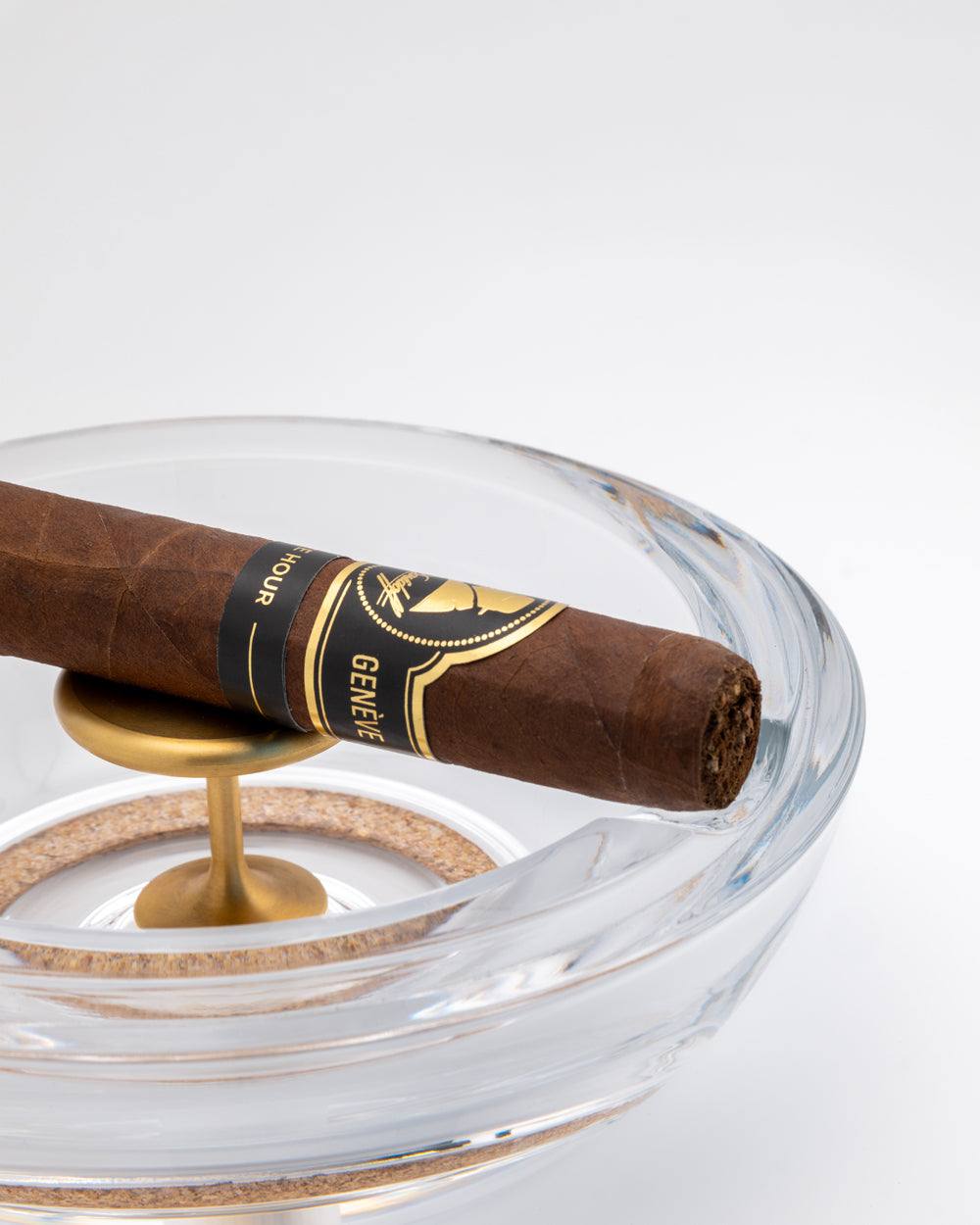
One channel, one tapper, no clutter
Under the dome, the base is as spare as the idea. A single channel is cut into the crystal to receive the cigar, sized generously: the maker rates it for anything up to a 74 ring gauge, which covers the thickest formats in a modern humidor with room to spare. At the centre stands a small brass tapper, milled to echo the shape of the handle on top of the dome. It does the two unglamorous jobs of the ritual. It gives the ash a clean edge to break against, and it holds the resting cigar up off the floor of the base.
The footing is a ring of inset cork, quiet against a table and kind to the crystal above it. Nothing about the assembly is permanent. The maker notes that the set comes apart for a proper cleaning, and its care instructions are correspondingly plain: wash by hand, use a soft cloth on the crystal, and unscrew the handle and the damper with a coin when the piece is stripped down. The damper, the instructions warn, is heavy. Objects at this level usually ask to be admired. This one also expects to be maintained, which is a more serious kind of design.
Six workshops, three countries
Murmmr developed the cigar version with Brian Telford of Telford's Pipe & Cigar in Mill Valley, the family tobacconist that has traded since 1970, an outside check on the design from a man who sells cigars for a living. The making itself is European and deliberately fragmented. The crystal comes from Bomma, the Czech foundry, and its machining from Stumpe Glas in Germany. Coatings are by Hartig, the brasswork by Heinz Mikolasch, the cork by Kork-Handel in Portugal, and the shipping crates by Schnurr, also in Germany. Six family run manufacturers in all, across three countries, working, the studio notes, in a fifth generation of craftspeople.
What San Francisco keeps for itself is the finishing. Each set is inspected, assembled, finished, engraved and packed at the studio before it leaves, one product at a time, in the order the studio was founded to work: slowly, and at a scale where the maker still knows which numbered set is going to whom. It is the opposite of the usual luxury arrangement, in which the famous name designs and anonymous factories make. Here the factories have names, generations and countries, and the famous name does the packing.
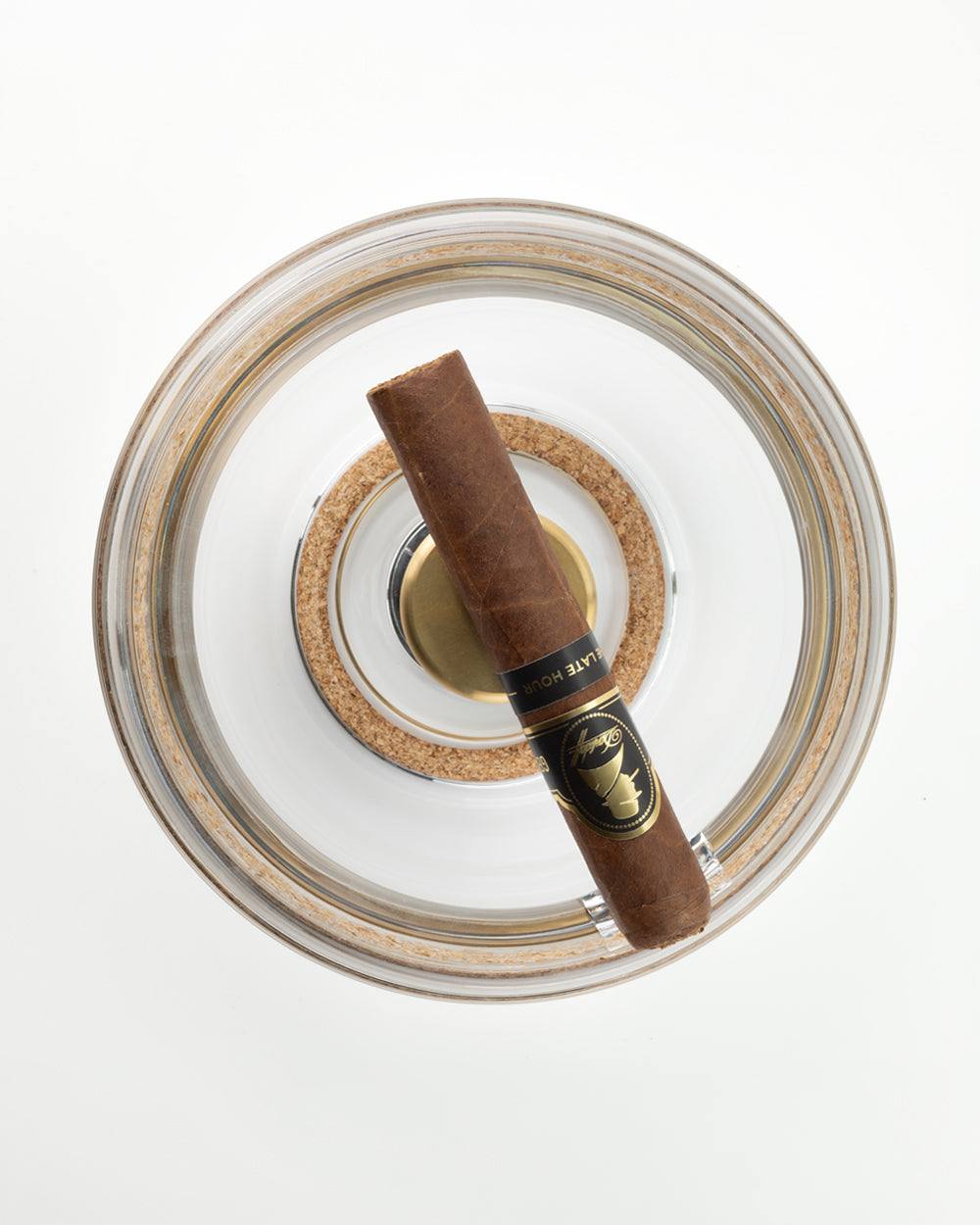
Numbered, torn, and kept on file
The Object: Cigar is an edition of 50 sets, each one numbered, with the number engraved into the base. A buyer's own line can sit beside it: personal engraving on the underside of the ashtray is included in the price, up to 25 characters, with the sensible warning that an engraved set cannot be returned. Provenance gets the same treatment as the crystal. Every set ships with a letterpress card: Jeremy Tinder designed it, and Aesthetic Union, a San Francisco letterpress shop, printed it. The card carries a unique three word passphrase, is keyed to the number of its set, and is then torn in half by hand. One half travels with the ashtray. Murmmr photographs and records the tear, the passphrase and the number, and keeps its half on file, so a set can be authenticated against a match no printer can reproduce.
The crate deserves a sentence of its own. Sets travel in a wooden crate made in Germany with a blackened Shou Sugi Ban finish, its lid held by six screws, and the studio offers a matching stand, The Rest: Cigar, a blackened oak base in rift sawn white oak, milled to fit the dome, at 130 dollars. Orders are quoted at six to eight business days before shipping. None of this is packaging theatre. It is the same idea as the dome, applied to freight: the object should arrive in the condition the ritual requires, undamaged and unhurried.
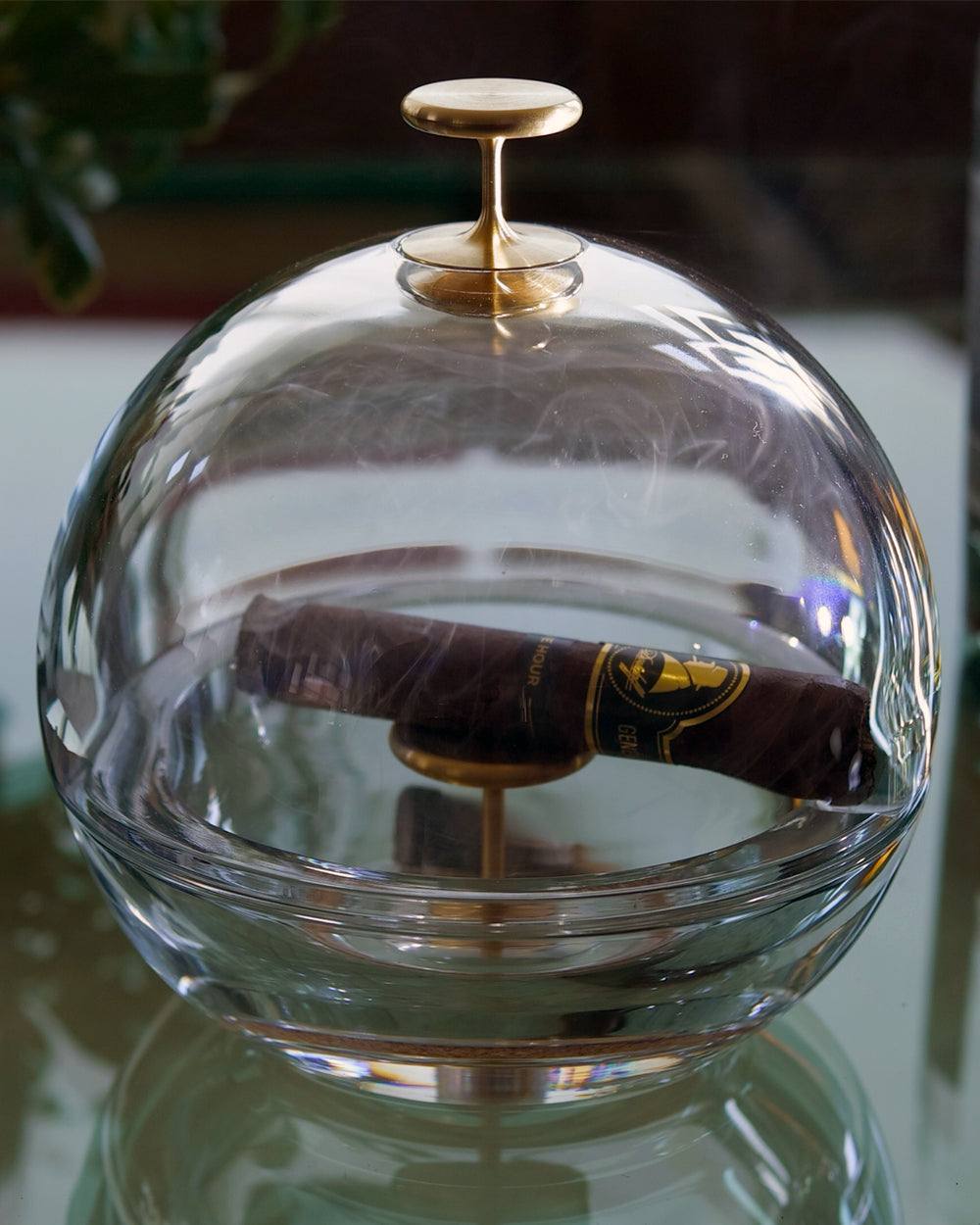
The room it belongs in
At 1,250 dollars, The Object: Cigar costs more than most smokers' humidors, and it will not pretend otherwise. What it buys is not storage, fire or cutting, the three jobs the ritual already has good tools for. It buys the fourth job, the one nobody had tooled: the interval. The minutes when the cigar is neither being smoked nor finished, when it sits at the mercy of a dish and a draught. Murmmr has given that interval a sealed glass room of its own, a brass rest, and a way back to the smoke that does not begin with an apology.
There is a reason this lands now. The culture around the cigar has been moving, for years, toward the unhurried version of itself: smaller rooms, longer evenings, one good cigar instead of three ordinary ones. An object that treats the pause as part of the smoke rather than an interruption of it belongs to that culture completely. The cigar, put down properly, waits. That is all the dome really promises, and it is enough.


