The Blender's Library
A blend is not invented. It is built, leaf by leaf and harvest by harvest, from a library of aged tobacco. Inside the blender's craft.

Before there is a cigar, there is a library. Not of books. Of leaf. Bales stacked by harvest year, by farm, by priming, aging in the dark while the blender decides what they will become.
The leaf is the vocabulary. The library is the memory. The blend is the sentence, rewritten every harvest until it reads the same.
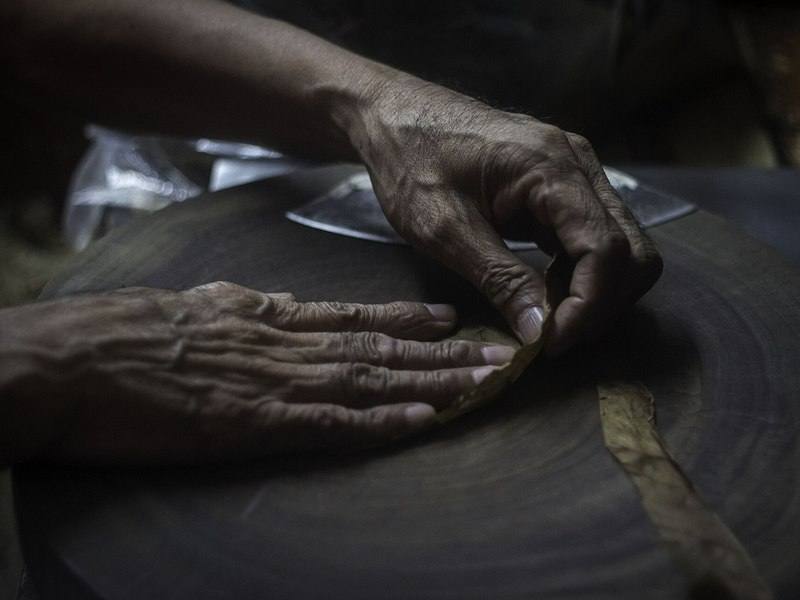
The master blender sets the proportion of every leaf in every cigar the factory rolls. The rollers receive their bundles already categorized: seco, volado, ligero. But which seco, from which farm, from which year: that is the blender's call.
The blender's office is the aging room. Bales are pulled, opened, smelled, and either approved or sent back for more time. Nothing is hurried. Tobacco on a schedule is tobacco ruined.
Smoke the parts first
Blenders taste components the way winemakers taste component wines. At Cigar Aficionado's 2024 Big Smoke seminar in Las Vegas, Ernesto Pérez-Carrillo and Tim Ozgener led more than 600 attendees through the exercise: crudely rolled single-leaf puritos, smoked one by one, before the finished cigars.
"I burn the leaf and smell it," Pérez-Carrillo told the room. "You want to smell the aroma and figure out how this particular tobacco will work with other inventory." Ozgener added that his family tried forty different tobaccos while building the CAO blends, and passed on his father's advice: write everything down.
The three leaves told the story in order. First a Nicaraguan seco from Jalapa, from the upper-middle priming, there for flavor. Then a Dominican Corojo '99 from La Canela, a dry region known for very strong leaf. "This one has more spice and more pepper. It's on the heavier side," Pérez-Carrillo said. "I could blend this with Nicaragua. If I see tears in your eyes then I know it's strong." Last came a dark Mexican San Andrés, the wrapper leaf. Then the room lit the finished cigars: an OZ Family Aramas A52 Toro holding all three tobaccos, and an E.P. Carrillo Sumatra Toro holding two. Same leaves, different proportions, different cigars. That is the whole lesson.
It is slow work. "Some tobaccos will smoke well on their own, but then when you blend them they don't work well together," Pérez-Carrillo said. "It takes a long time. Sometimes you think you have something great and then after 30 days, you say: what happened to this cigar? The cigar keeps evolving."
Ligero, seco, volado
The filler's grammar has three words. Ligero, the top priming: strength and body. Seco, the middle: aroma. Volado, the lower leaves: combustion. A full-bodied cigar carries more ligero. A mild one leans on seco and volado. The proportions are the blend.
Change one leaf and the cigar changes. Swap the seco and the aroma shifts. Add ligero and the strength climbs. Every change is smoked and judged before it is approved, the parts before the whole.
Prototypes are rolled in small batches and smoked over weeks, not days. A blend that sings on day one can fall apart on day thirty. The blender waits.
Fire in the pilón
Long before blending, the leaf must be tamed. After curing, tobacco is stacked in pilones, piles weighing thousands of pounds. The weight and residual moisture generate heat, and the pile ferments from the inside out. In the Cuban method the first cycle is held to 35 degrees Celsius at the core, and no more.
The blender watches the pile's core with long thermometers. When the center peaks, the pilón is broken down and rebuilt: center leaves to the top, top leaves to the bottom, bottom leaves toward the center. The turning repeats until every leaf has taken its turn in the heat. The process sweats out ammonia, lowers nicotine, and darkens the leaf. Thicker leaves, the oily top primings, ferment longest.
Cuban practice adds a second fermentation. Undercap and filler leaves are packed into burros weighing up to 2,000 kilograms and fermented for up to sixty days, with the temperature never allowed past 42 degrees Celsius. Untying and rebuilding a single burro takes four people four hours. The stage ends when the temperature stabilizes.
The library
After fermentation comes aging: six months to several years, the most aromatic leaves longest. Each batch is labeled by harvest year, leaf type, and the date aging began. This is the library the blender draws on.
A library is only as good as its catalog. Every bale carries its history on a tag: the harvest, the farm, the priming, the day fermentation ended and aging began. The blender reads these tags the way a chef reads a market list.
The great houses keep deep reserves. Padrón's published aging minimums run from two and a half years for the classic series to four for the 1964 Anniversary, no less than five for the Serie 1926, and no less than ten for the Family Reserve. As of 2003 the company held 75,000 square feet of Estelí storage, inventory for more than 25 million cigars: six years of production.
Arturo Fuente's published formula is simpler: in any given year, get more tobacco than the year's production needs and roll more cigars than the sales team will sell. Their aging rooms hold cigars with years of rest, sometimes a decade.
Holding the line
Tobacco changes every harvest with the weather, so the blend must change to stay the same. Altadis keeps a tasting panel whose work includes making sure current blends match the house flavor year after year.
Claudio Sgroi, president and master blender of Mombacho, puts it plainly: "You can have the best tobacco in the world and make a poor liga, or have mediocre tobacco and make a decent liga." He adds that even well-processed young tobacco needs two to three years of rest for a good result.
Ask a blender for the secret and you will get a shrug, not a formula. The secret is time, temperature, and ten thousand small decisions, none of them written down except the ones that matter.
That is the blender's craft in one line. The leaf is the vocabulary. The library is the memory. The blend is the sentence, rewritten every harvest until it reads the same.
It is the least visible job in the factory and the most consequential. The roller builds the cigar. The blender decides what it will be.